Baroque Floral Embroidery Review
A Timeless Motif, Thoughtfully Simplified
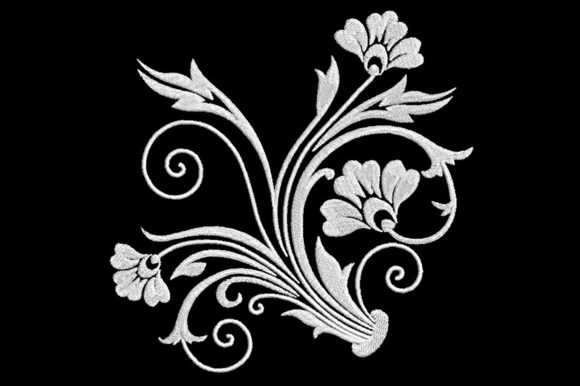
When I first opened the Baroque Floral embroidery file on Creative Fabrica, I wasn’t expecting grandeur—but I was pleasantly surprised by its quiet confidence. This isn’t a fussy, over-rendered Baroque revival. Instead, it’s a distilled interpretation: scrolling vines, soft petal curves, and balanced negative space all contained neatly within a 5″ x 5″ hoop size. As an embroidery designer who regularly sources digital embroidery files for client work, I appreciate how Baroque Floral walks the line between ornamental charm and practical execution. It reads as elegant without demanding advanced digitizing knowledge—or your machine’s patience.
Fits Naturally Into Real-World Projects
I tested Baroque Floral across several real product categories before committing to a customer order: a linen apron for a local bakery, a cotton baby blanket for a newborn announcement, and a midweight canvas tote for a boutique gift set. In each case, the design held up—not just visually, but structurally. Its single-color, no-thread-change construction made it ideal for quick turnaround jobs, especially when juggling multiple small-batch orders. Because it’s categorized under Shapes and labeled as an Embroidery file, it’s clearly intended as a standalone motif—not an applique design or layered monogram. That simplicity is its strength.
Performance on Common Fabrics & Surfaces
Baroque Floral shines on stable, medium-weight fabrics—think quilting cotton, twill, denim, and medium-knit sweatshirts. On a brushed cotton sweatshirt, the satin stitch elements retained crisp definition thanks to moderate stitch density; no puckering, no skipped stitches. I used a light cutaway stabilizer beneath and a tear-away on top, which gave clean coverage without stiffness. For curved surfaces like caps, I’d recommend testing first: while the 5″ x 5″ hoop size fits most standard cap frames, the outer vine elements sit close to the edge—so precise hooping matters. On stretchy knits, add a light fusible topping to prevent distortion during stitching.
Dark fabric? Yes—it works. Since it’s a one-color design, contrast becomes your main lever. I stitched it in ivory thread on navy chambray and charcoal linen with excellent legibility. No tiny lettering or micro-details to vanish—just confident, open shapes that read clearly even at arm’s length. That’s critical for products like kitchen towels or pillow covers, where buyers expect visual impact from across the room.
Washability & Long-Term Wear
After three rounds of gentle machine washing (cold, air-dried), my test samples showed zero fraying, loosening, or color bleed. The fill stitch areas remained smooth and consistent—not overly dense, not too sparse. That balance helps durability: too much density stresses fabric fibers over time; too little invites snagging. Baroque Floral avoids both pitfalls. For baby blankets or nursery decor, this reliability builds trust—handmade customers care deeply about safety and longevity, not just aesthetics.
Commercial Use Considerations
If you sell on Etsy or supply boutiques, Baroque Floral supports brand consistency without limiting creativity. It’s versatile enough to anchor a seasonal collection—say, gold thread on black velvet for holiday pillows, or moss green on oatmeal linen for spring aprons. Because it’s a clean, scalable shape, it also translates well into printable mockups for your listings. No need to over-edit: the proportions hold up in thumbnails and detail shots alike.
For embroidered patches, I’d suggest stitching it on twill-backed fusible web, then heat-sealing and finishing edges cleanly. As a standalone motif on a tote bag design, it adds artisanal weight without overwhelming the canvas. And because it requires no color changes, production time stays low—valuable when fulfilling custom apparel orders or craft fair inventory.
Design Integrity & Handmade Presentation
What elevates Baroque Floral beyond utility is its intentional restraint. Many floral embroidery files lean into hyper-realism or excessive layering—but this one embraces flatness as a stylistic choice. That makes it feel authentically handmade, not digitally mass-produced. Buyers notice that subtlety: it reads as considered, not automated. When photographing finished products, the motif’s symmetry and clarity enhance composition—no post-editing needed to “fix” muddy details.
Practical Notes Before You Stitch
- Always test on scrap fabric—especially if using textured weaves or dark substrates.
- Confirm the exact hoop size and file formats included (check the Creative Fabrica product page) before purchasing—some versions may include alternate sizes or formats useful for commercial embroidery setups.
- Review stitch density in your embroidery software: look for tight corners or overlapping fill areas that might benefit from slight manual cleanup.
- Use appropriate stabilizer for your base fabric—light cutaway for knits, tear-away for stable wovens.
- Inspect small details after stitching: check vine tips and petal ends for stray threads or minor trimming needs.
- Verify licensing terms on the Creative Fabrica page before selling finished items—commercial use rights vary by seller and product type.
Final Thoughts for Designers & Sellers
Baroque Floral won’t replace complex heirloom-digitized motifs—but it fills a vital niche: reliable, beautiful, and production-ready. It’s the kind of machine embroidery design that helps small business owners scale thoughtfully, without sacrificing quality or aesthetic cohesion. Whether you’re building a cohesive line of nursery decor, launching a capsule collection of custom apparel, or sourcing dependable design assets for seasonal handmade gifts, Baroque Floral delivers quiet sophistication with zero friction. It’s proof that sometimes, the most effective embroidery file isn’t the flashiest—it’s the one that simply works, beautifully, every time.